
Structural heart interventions treat defects in the heart’s walls, valves, and chambers using catheter-based approaches – without open-heart surgery. Dr. Arun Kalyanasundaram trained in structural heart disease at the Cleveland Clinic Foundation and offers catheter-based structural procedures at Promed Hospital, Chennai.
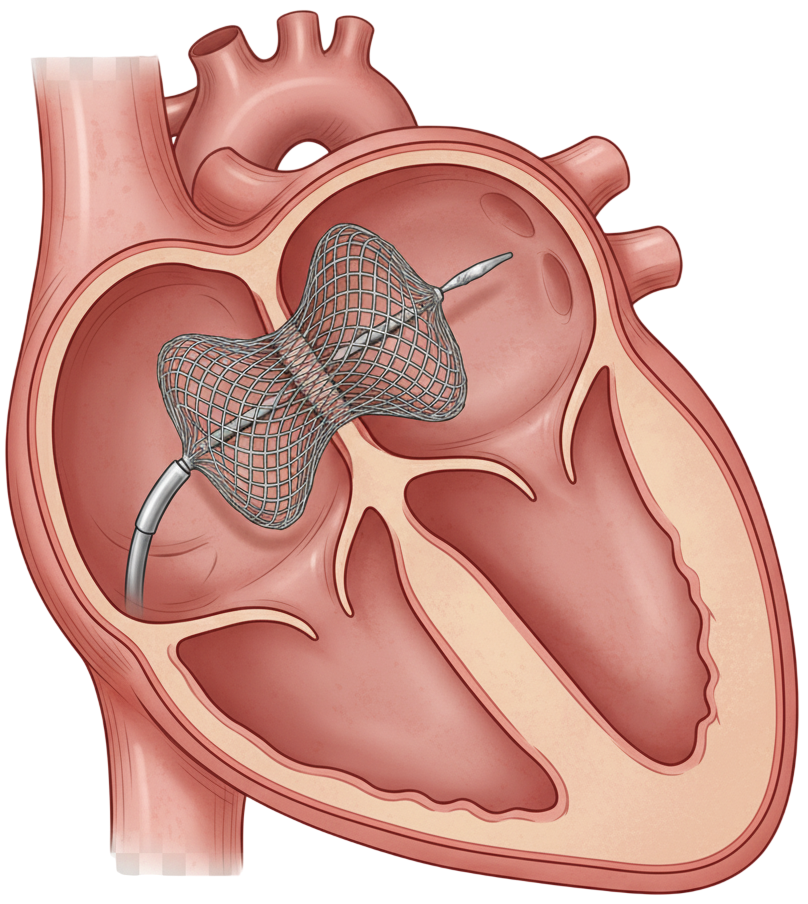
Structural heart disease refers to abnormalities of the heart’s physical architecture – its walls, valves, and chambers – as distinct from disease of the coronary arteries. These include holes in the wall between chambers, narrowed or leaking valves, and gaps around previously implanted artificial valves.
For decades, the only treatment for many of these conditions was open-heart surgery. Today, a growing range can be treated with catheter-based (transcatheter) techniques – delivering occluder devices and balloons through a small puncture in a vein or artery, guided by real-time imaging. For suitable patients, this means no chest incision, no cardiopulmonary bypass, shorter hospital stays, and faster recovery.
Atrial Septal Defect
Transcatheter closure of atrial septal defects using an occluder device. A hole in the wall between the heart’s two upper chambers is sealed with a self-expanding device delivered through a vein – avoiding open-heart surgery. Most patients are discharged within 1–2 days.
Patent Foramen Ovale
Closure of patent foramen ovale, commonly performed after a cryptogenic stroke to reduce recurrence risk. A flap-like opening between the upper chambers – present in roughly 1 in 4 adults – is closed with an occluder device in carefully selected patients.
Stenotic Valve Relief
Catheter-based relief of stenotic (narrowed) valves – mitral and pulmonary valvuloplasty. A balloon is positioned across the narrowed valve and inflated to widen the opening. Balloon mitral valvuloplasty is a well-established treatment for rheumatic mitral stenosis.
Prosthetic Valve Leak
Closure of leaks around prosthetic heart valves using catheter-based occluder devices. A gap that develops around the edge of a previously implanted artificial valve is sealed – avoiding the higher risk of repeat open-heart surgery in suitable cases.
An atrial septal defect is a hole in the wall (septum) between the two upper chambers of the heart, present from birth. It allows abnormal blood flow between the chambers and, over time, can enlarge the heart and raise pressure in the lungs. Most ASDs can be closed without open-heart surgery using a transcatheter occluder device delivered through a vein in the leg. The device is positioned across the defect under echocardiographic guidance, where it seals the hole. Most patients are discharged within 1–2 days.
A patent foramen ovale (PFO) is a small flap-like opening between the upper heart chambers that fails to seal after birth - present in about 1 in 4 adults. In most people it causes no problems, but in some patients who have had a cryptogenic stroke (a stroke with no other identified cause), a PFO can allow a clot to pass from the venous side to the arterial side and travel to the brain. Transcatheter PFO closure has been shown to reduce the risk of recurrent stroke in carefully selected younger patients with cryptogenic stroke.
Critical limb ischaemia (CLI) is the most severe form of peripheral artery disease, where blood flow is so reduced that the limb is threatened. It presents as rest pain (pain in the foot even at rest, often worse at night), non-healing wounds, or gangrene. CLI is a limb-threatening emergency requiring urgent intervention to restore blood flow and prevent amputation. Without revascularisation, a significant proportion of CLI patients face major amputation within a year.
Balloon valvuloplasty is a catheter-based procedure to relieve a stenotic (narrowed) heart valve without surgery. A balloon is positioned across the narrowed valve and inflated to widen the opening and improve blood flow. It is most commonly performed for mitral valve stenosis (often from rheumatic heart disease) and pulmonary valve stenosis. For suitable patients, balloon mitral valvuloplasty can provide durable symptom relief and is a well-established alternative to valve surgery.
A paravalvular leak is a gap that develops around the edge of a previously implanted prosthetic (artificial) heart valve, allowing blood to leak around the valve. It can cause heart failure symptoms and damage to red blood cells (haemolysis). In suitable cases, the leak can be closed using a catheter-delivered occluder device - avoiding the higher risk of repeat open-heart surgery. These are complex procedures requiring detailed pre-procedural imaging and echocardiographic guidance.
All structural interventions are performed under combined echocardiographic and fluoroscopic guidance. ASD and PFO closures use femoral venous access with a transseptal puncture to reach the atrial septum; left-sided procedures use arterial access. Pre-procedural CT and echocardiographic planning is standard, and transoesophageal or intracardiac echocardiography guides device positioning in real time during the procedure.
Dr. Arun Kalyanasundaram trained in structural and peripheral vascular intervention at the Cleveland Clinic Foundation, one of the world's leading cardiovascular centres, following his interventional cardiology fellowship. He offers catheter-based structural procedures at Promed Hospital, Chennai, combining structural heart expertise with his complex coronary and CTO practice.
+91 94807 94807
director@ctomd.com
Among India’s most experienced CTO PCI specialists.
Cleveland Clinic-trained.
Asia-Pacific CTO Club India Director.
Dr. Arun Kalyanasundaram is a Chennai-based CTO PCI specialist providing advanced coronary intervention, CTO angioplasty, blocked artery treatment, second opinions, and treatment planning for patients from Mumbai, Delhi, Bangalore, Hyderabad, Pune, Kolkata, Ahmedabad, Chandigarh, Kochi, Visakhapatnam, and throughout India.
Promed Hospital
1/10A East Coast Road, Kottivakkam
Chennai, Tamil Nadu 600041