
If your previous angioplasty or stent has failed – the artery has re-blocked, the stent has not expanded properly, or a new blockage has formed inside the stent – there are treatment options available. Failed PCI and in-stent restenosis are problems with defined causes and, in the hands of an experienced specialist, defined solutions.
Every failed PCI case referred to Dr. Arun Kalyanasundaram begins with a systematic review of the original angiogram and procedural report from the prior attempt. Understanding what was tried, what failed, and why is the foundation of an effective redo strategy. A second opinion that includes this analysis – before committing to a repeat procedure – is the appropriate first step.
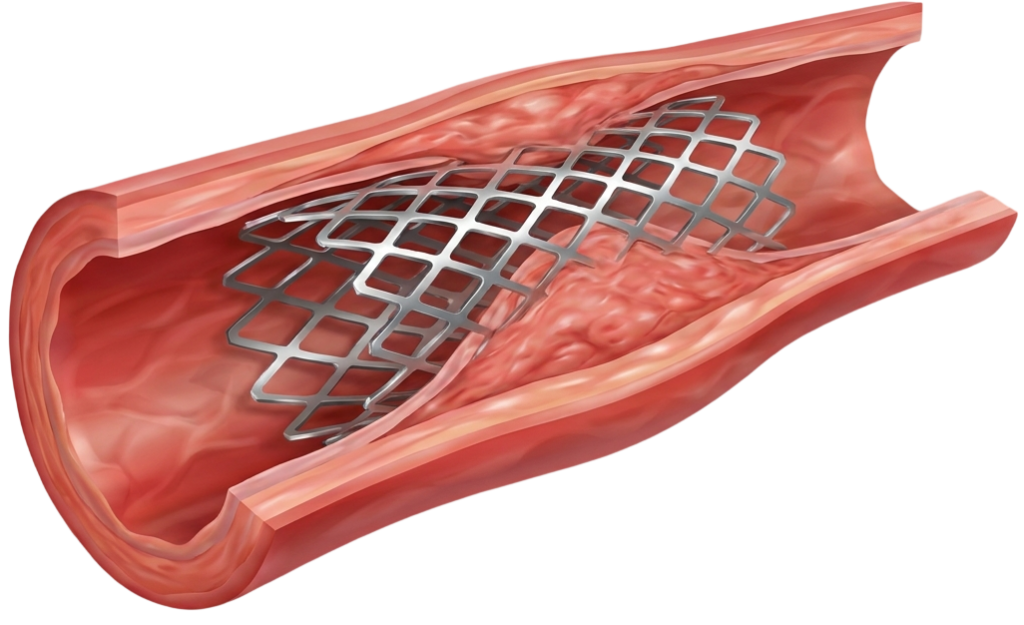
There are four distinct mechanisms. Identifying which one caused a given failure is the entire basis of choosing the right redo strategy – and the reason a systematic angiographic review precedes any repeat procedure.
Most common failure mode. Re-narrowing inside the stent due to neointimal hyperplasia – tissue regrowth inside the stent. More common in calcified arteries, small vessels, long stented segments, and diabetics. With modern drug-eluting stents, ISR rates are 5–10% in uncomplicated lesions but significantly higher in calcified or complex anatomy.
Stent does not expand fully due to severe calcification restraining the stent. Creates zones of abnormal flow, platelet activation, and turbulence – driving both restenosis and thrombosis risk. This is preventable with imaging-guided calcium modification before stenting.
Acute blood clot inside the stent, typically causing a heart attack. Closely associated with stent underexpansion from inadequate calcium modification. Less common but more acute than ISR.
Failed CTO attempt, partially treated lesion, or procedural strategy not optimised for the anatomy – leaving the patient with incomplete revascularisation.
Re-narrowing inside a previously placed stent causing return of angina or a new ischaemic event. Treatment depends on cause and pattern:
CTO attempted elsewhere using only antegrade wiring that failed. Retrograde technique or ADR including K14 may open the artery at a dedicated CTO programme. Dr. Arun reviews the original angiogram and procedure report to assess what was tried, what failed, and what different strategy would be appropriate.
Stent deployed without adequate calcium modification that cannot be expanded despite high-pressure balloon inflation. IVL within the stent fractures the constraining calcium, allowing full stent expansion. Dr. Arun performs this type of redo intervention routinely.
Saphenous vein grafts placed during previous CABG developing stenosis or occlusion years later. Native vessel CTO PCI may offer a better long-term solution than graft re-intervention - treating the native coronary artery below the failed graft rather than the graft itself.
In-stent restenosis is treatable in the majority of cases. The treatment depends on the cause and pattern of restenosis. Focal restenosis at a stent edge is typically treated with a drug-eluting balloon or a new drug-eluting stent. Diffuse in-stent restenosis throughout the stent body may require a repeat stent or, in some cases, surgical revascularisation. If calcium was the underlying cause of stent underexpansion leading to restenosis, intravascular lithotripsy within the original stent can modify the calcium and allow full re-expansion. Dr. Arun reviews the original stenting procedure and mechanism of failure before recommending a redo approach.
Yes. Particularly for CTO PCI failures, referral to a high-volume specialist programme can result in successful opening of an artery that failed at a lower-volume centre. The key is understanding what was attempted and why it failed. If antegrade wiring was the only strategy tried, retrograde technique or ADR using the CrossBoss-Stingray platform — including the K14 technique developed by Dr. Arun — may succeed where the prior attempt did not.
Not necessarily. Failed CABG is a common clinical scenario with multiple potential treatment pathways. If the native coronary arteries below the failed graft are patent or can be revascularised by CTO PCI, native vessel revascularisation may provide a better long-term solution than graft re-intervention. If the graft itself is diseased, percutaneous intervention on the graft may be an option depending on the anatomy. These are complex cases requiring expert multi-modality angiographic assessment.
There are four main causes. In-stent restenosis is re-narrowing inside the stent from tissue regrowth (neointimal hyperplasia) — the most common failure mode. Stent underexpansion occurs when severe calcification prevents the stent from fully expanding. Stent thrombosis is an acute clot inside the stent, often related to underexpansion. Technical failure includes incompletely treated lesions or a procedural strategy not optimised for the anatomy. Identifying which mechanism caused the failure is essential before any redo procedure.
In-stent restenosis (ISR) is re-narrowing inside a previously placed stent due to neointimal hyperplasia — tissue regrowth inside the stent. It is more common in calcified arteries, small vessels, long stented segments, and diabetic patients. With modern drug-eluting stents, ISR rates are 5–10% in uncomplicated lesions but significantly higher in calcified or complex anatomy. ISR typically presents as a return of angina within 6–12 months of the original procedure.
Yes. Stent underexpansion from calcium can be treated with intravascular lithotripsy (IVL) inside the original stent. IVL generates sonic pressure waves that fracture the constraining calcium, allowing the stent to be further expanded with a high-pressure balloon. This is sometimes called "lithotripsy for undilatable stents." Dr. Arun Kalyanasundaram performs this redo intervention routinely. The first step is IVUS assessment to confirm that calcium underexpansion — not restenosis tissue — is the cause.
+91 94807 94807
director@ctomd.com
Among India’s most experienced CTO PCI specialists.
Cleveland Clinic-trained.
Asia-Pacific CTO Club India Director.
Dr. Arun Kalyanasundaram is a Chennai-based CTO PCI specialist providing advanced coronary intervention, CTO angioplasty, blocked artery treatment, second opinions, and treatment planning for patients from Mumbai, Delhi, Bangalore, Hyderabad, Pune, Kolkata, Ahmedabad, Chandigarh, Kochi, Visakhapatnam, and throughout India.
Promed Hospital
1/10A East Coast Road, Kottivakkam
Chennai, Tamil Nadu 600041