
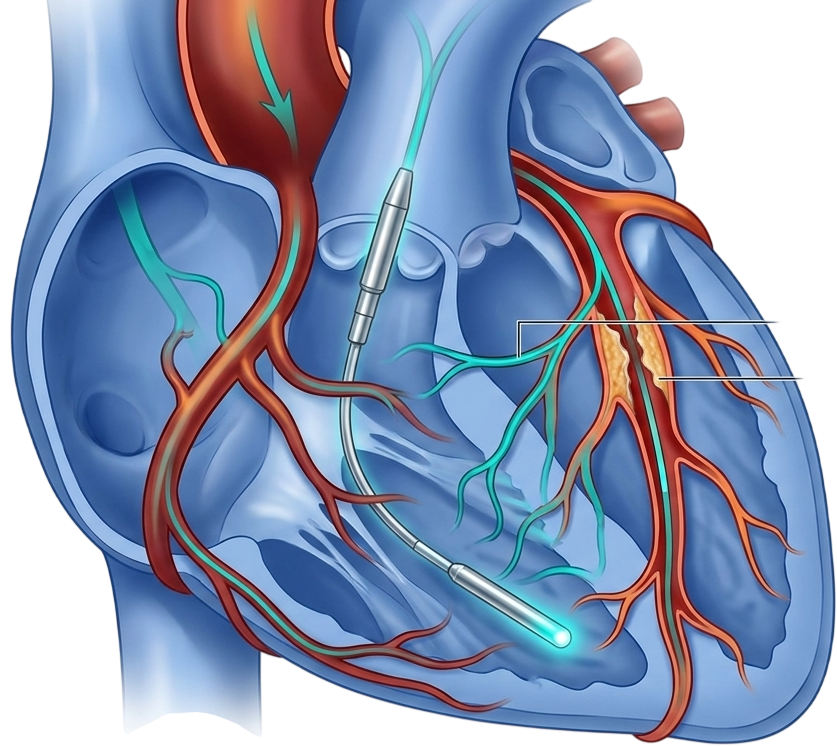
The retrograde technique is the most technically demanding strategy in CTO PCI, reserved for cases where antegrade approaches have failed or where the anatomy makes antegrade success anatomically unlikely. It requires navigating guidewires backwards through microscopic collateral channels to reach the blocked artery from the other side. Dr. Arun Kalyanasundaram performs this technique routinely – including in cases referred after failed attempts elsewhere.
If your CTO PCI attempt failed at another hospital, it does not mean the artery cannot be opened. The retrograde approach – going in from the other side – may succeed where the forward approach did not. This is exactly the type of case Dr. Arun Kalyanasundaram is referred from across India and the Asia-Pacific.
Success Rate (Complex Cases
Major Collateral Complication
Registry Contributor
ERCTO Score Research
In standard antegrade CTO PCI, the operator works forward – in the same direction as normal blood flow – attempting to cross the blocked segment from the proximal end to the distal end. In retrograde CTO PCI, the operator approaches from the opposite direction: a guidewire is advanced backwards through collateral channels (small bridging vessels connecting different coronary arteries) to reach the distal end of the blocked artery, and the CTO is then crossed from the distal side toward the proximal cap.
In the Hybrid CTO Algorithm – the international framework for CTO strategy selection that Dr. Arun co-authored – retrograde technique is considered as a primary strategy from the outset in specific high-risk anatomies, not merely as a last resort after antegrade has failed. Attempting prolonged failed antegrade approaches before switching to retrograde wastes radiation dose, contrast, and time – and risks converting a tractable retrograde case into a complication.
The introduction of the retrograde approach has driven overall CTO PCI success rates from approximately 70% to 90% over the past 15–17 years, according to published registry data. Retrograde technique is currently used in 20–50% of CTO PCIs worldwide, depending on operator and centre.
The decision to choose retrograde over antegrade is made upfront, during pre-procedural angiographic assessment – not after antegrade has been attempted and failed. The Hybrid CTO Algorithm specifies the anatomical features that predict antegrade failure, and these are the features that flag retrograde as the appropriate primary strategy.
Collateral vessels are small natural bridging channels that develop when a coronary artery becomes severely narrowed or blocked. The heart grows these channels to partially compensate for lost blood flow – but they are thin, tortuous, and fragile. Using them as a retrograde access route requires extraordinary technical delicacy. The choice of channel – septal versus epicardial – substantially affects both success and complication risk.
Success Rate (ERCTO)
Complication Rate
Run through the interventricular septum – the muscular wall between the left and right ventricles. Connect branches of the right coronary artery to branches of the LAD, or vice versa.
Generally preferred for retrograde access: the septum tolerates wire manipulation better than the epicardial surface, and perforation into the septum is less dangerous than perforation in the epicardial space – septal perforations are typically managed conservatively without pericardial intervention.
Septal collaterals are used in approximately 62–68% of retrograde CTO PCI cases according to PROGRESS-CTO, ERCTO, and Asia-Pacific registry data.
Success Rate (ERCTO)
Complication Rate
Run along the outer surface of the heart, typically connecting the posterior descending artery to marginal branches or the LAD.
More tortuous and fragile than septal collaterals – and unprotected by surrounding myocardium. Higher perforation risk with potential for tamponade if recognition or response is delayed. Epicardial perforation requires rapid recognition and active management.
Used in approximately 20–32% of retrograde cases – typically when no suitable septal collateral exists. Softer microcatheters such as the Caravel are preferred over the more rigid Corsair when traversing epicardial connections.
Retrograde CTO PCI requires dual arterial access – a catheter in the coronary artery containing the CTO (the recipient vessel, approached from the antegrade direction) and a separate catheter in the donor vessel that supplies the collaterals. Both arteries are visualised simultaneously throughout the procedure.
A guiding catheter is positioned in the donor coronary artery - the vessel supplying the collateral channels used for retrograde access. Contrast injections under high magnification map the collateral anatomy and select the best channel: longest visible length, straightest course, and connection to the distal segment of the CTO vessel. Selection at this stage is the single most important determinant of subsequent success.
Dedicated low-tip-load retrograde guidewires - such as the Suoh 03 (1.2 g tip load) or SION Blue — are advanced through the selected collateral channel, supported by a soft microcatheter (Caravel or Corsair Pro XS). The wire is torqued very gently to navigate the channel's bends without perforating the fragile wall. Microcatheter advancement follows the wire only after each successful segment is confirmed by injection.
Once the microcatheter has crossed the collateral and reached the distal CTO vessel, a more penetrating wire (such as a Gaia, Conquest Pro, or Astato) is exchanged into the retrograde system. This wire is advanced retrograde into the CTO body - working from the distal cap toward the proximal cap, opposite to the direction of blood flow.
The most common technique for completing retrograde CTO PCI is Reverse CART (Controlled Antegrade and Retrograde Subintimal Tracking). The antegrade balloon is inflated in the proximal subintimal space to create an enlarged channel. The retrograde wire is steered into this space and then into the antegrade guide catheter — a manoeuvre called externalisation. Once externalised, an over-the-wire technique allows the CTO to be stented from the proximal landing zone to the distal true lumen. Guide-extension-assisted Reverse CART has progressively replaced conventional Reverse CART since 2016, providing additional support and safety.
After successful crossing and externalisation, the CTO segment is predilated, stented with drug-eluting stents, and post-dilated under IVUS guidance to ensure complete stent expansion. Final angiography in both the recipient vessel and the donor vessel confirms patency, collateral integrity, and absence of complications. The donor vessel injection is essential - a previously patent collateral may have perforated silently during the procedure and must be excluded before completion.
The safety of retrograde CTO PCI has been extensively studied through the PROGRESS-CTO Registry – the world’s largest prospective CTO PCI dataset – and the European Registry of Chronic Total Occlusion Interventions (ERCTO). Dr. Arun Kalyanasundaram is a contributing author to multiple PROGRESS-CTO publications and has authored or co-authored key papers defining contemporary retrograde safety standards.
The retrograde technique is used when the CTO anatomy makes antegrade crossing unlikely to succeed, or when antegrade attempts have already failed. Specific anatomical features that favour retrograde from the outset include a completely ambiguous or buried proximal cap, a very long heavily calcified occlusion, and a case where the distal vessel is well-visualised via collaterals but the proximal approach is technically unfavourable. Dr. Arun uses the Hybrid CTO Algorithm to decide upfront whether a case is better approached retrograde, antegrade, or with a planned escalation strategy.
Yes. Cases referred after failed antegrade attempts at other centres are a regular part of Dr. Arun Kalyanasundaram's practice. If the prior attempt used only antegrade wiring, retrograde technique may succeed where the earlier attempt did not. The key is a fresh angiographic assessment to understand the current anatomy - what has changed since the prior attempt, where the subintimal dissection has tracked, and what collateral channels are available.
The complication profile of retrograde CTO PCI is distinct from standard angioplasty. The primary retrograde-specific risk is collateral perforation, which occurs in fewer than 1% of cases for major events at high-volume centres and is manageable when recognised promptly. The overall major adverse event rate in experienced hands is comparable to complex standard PCI. The risks must be weighed against the benefits of treating the CTO - relief of angina, improvement in heart function, and reduction in ischaemia.
At high-volume specialist centres, technical success for retrograde CTO PCI is 70–85%, lower than antegrade-only cases because retrograde is preferentially used for the most complex anatomy. ERCTO Registry data shows 83% success when septal collaterals are used and 77% with epicardial collaterals. The introduction of retrograde technique has driven overall CTO PCI success rates from approximately 70% to 90% over the past 15–17 years.
Collaterals are small natural bridging vessels that grow when a coronary artery becomes severely narrowed or blocked. Septal collaterals run through the interventricular septum - the muscular wall between the ventricles - and connect branches of the right coronary artery to branches of the LAD. Epicardial collaterals run along the outer surface of the heart, connecting different coronary territories. Septals are preferred for retrograde access because septal perforation is less dangerous than epicardial perforation, which risks tamponade.
Reverse CART (Controlled Antegrade and Retrograde Subintimal Tracking) is the most common completion technique for retrograde CTO PCI. The antegrade balloon is inflated in the proximal subintimal space to create an enlarged channel. The retrograde wire is then steered into this enlarged space and externalised through the antegrade guide catheter. Once externalised, stent delivery proceeds in a controlled fashion from proximal to distal true lumen. Guide-extension-assisted Reverse CART has progressively replaced conventional Reverse CART since 2016.
+91 94807 94807
director@ctomd.com
Among India’s most experienced CTO PCI specialists.
Cleveland Clinic-trained.
Asia-Pacific CTO Club India Director.
Dr. Arun Kalyanasundaram is a Chennai-based CTO PCI specialist providing advanced coronary intervention, CTO angioplasty, blocked artery treatment, second opinions, and treatment planning for patients from Mumbai, Delhi, Bangalore, Hyderabad, Pune, Kolkata, Ahmedabad, Chandigarh, Kochi, Visakhapatnam, and throughout India.
Promed Hospital
1/10A East Coast Road, Kottivakkam
Chennai, Tamil Nadu 600041