
Patients who arrive at CHIP have often been told the same thing: nothing more can be done. Bypass is too risky. The remaining vessel is too critical to touch. CHIP PCI is built specifically for this patient — full mechanical circulatory support (IABP, Impella, ECMO), imaging-guided technique, and the operator judgement that defines outcomes when the margin for error is narrow.
Founder
Full Support
Managed Routinely
Training
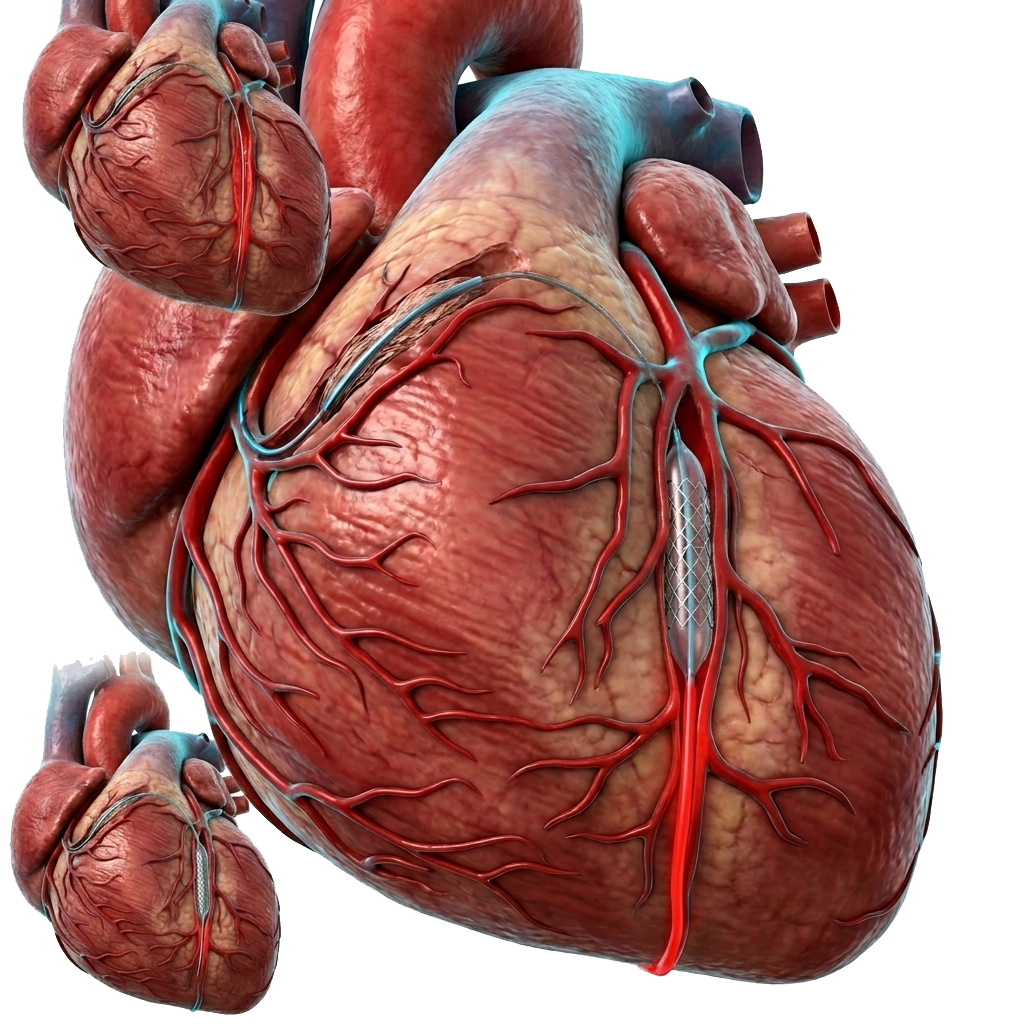
CHIP — Complex, Higher-risk, Indicated PCI — is not a single procedure. It is a clinical category describing coronary intervention performed when two conditions are simultaneously true: the patient has a clear clinical indication for revascularisation (symptoms, ischaemia, or reduced heart function that intervention can address), and the risk of the procedure is substantially elevated due to patient-related or anatomy-related factors. A cardiologist who manages standard angioplasty well is not automatically equipped to manage CHIP safely.
The CHIP population has grown significantly as the Indian population ages. More patients present with advanced coronary artery disease in the context of serious competing illnesses — diabetes, chronic kidney disease, previous heart attacks, severely impaired heart function. Many are referred for bypass surgery (CABG) and declined because their surgical risk is prohibitively high. They are referred to an interventional cardiologist for better therapeutic options.
Dr. Arun Kalyanasundaram is the Founding Course Director of CHIP-CTO INDIA — India’s first and only conference dedicated exclusively to Complex Procedure Indicated Patients and CTO interventions. Running annually since 2019, it is the primary national platform for training Indian cardiologists in CHIP standards.
When the heart's pumping capacity falls below 35%, the haemodynamic margin for error during PCI is narrow. The heart cannot tolerate the transient drops in output that occur during balloon inflation or ischaemic episodes. These patients require myocardial viability assessment to confirm that revascularisation will recover function, and haemodynamic support planning to protect the circulation during the intervention.
Some patients present with two of their three major coronary arteries occluded, with the one remaining patent vessel supplying the entire surviving myocardium. Treating a lesion in this "last remaining vessel" carries extreme risk — a complication would be immediately life-threatening. This scenario requires absolute haemodynamic preparedness, optimal imaging, and a procedural approach that minimises ischaemic time.
When a cardiac surgery team declines to operate due to prohibitively high risk — severe lung disease, previous open-heart surgery with dense adhesions, extreme frailty, or multiple comorbidities — PCI becomes the only revascularisation option. These patients are often told nothing can be done. In the CHIP framework, a carefully planned percutaneous intervention can be both feasible and clinically beneficial in many of these cases.
The left main coronary artery supplies approximately 70–80% of the left ventricle's blood supply. Disease of the unprotected left main — where no bypass graft is present as a safety net — carries a disproportionate risk. Any complication affecting this vessel is immediately haemodynamically devastating. Left main PCI in this setting requires the highest level of preparation and operator experience.
Triple-vessel disease with diffuse or calcified lesions, bifurcation involvement, and prior failed interventions. The decision about which lesion to treat first, whether to use staged versus complete revascularisation, and how to manage competing anatomy can be as consequential as the technical execution of stent deployment itself.
The highest-acuity end of the CHIP spectrum. Acute decompensated heart failure or cardiogenic shock superimposed on coronary artery disease requires immediate haemodynamic support and rapid lesion assessment. Often a "culprit-only" revascularisation strategy first to stabilise, then complete intervention.
Intra-Aortic Balloon Pump
Reduces cardiac workload. Modest support, widely available. Standard pre-procedural support for high-risk left main and multi-vessel CHIP cases.
Micro-Axial LV Assist
Extracorporeal Membrane Oxygenation
Review of all available angiographic data, LV function assessment by echo or cardiac MRI, and viability imaging where indicated. Confirms that the territory at risk will benefit from revascularisation before entering the catheterisation laboratory.
Support device determined in advance. Placed before the intervention begins in high-risk cases — not as rescue after haemodynamic collapse.
Angiography alone is inadequate for CHIP stent planning. IVUS provides real-time cross-sectional imaging for accurate vessel measurement, calcium quantification, and stent expansion confirmation. OCT provides even higher-resolution imaging in calcified lesions.
Many CHIP patients have heavily calcified lesions that prevent adequate stent expansion. Rotational atherectomy (140,000–180,000 RPM diamond burr) and intravascular lithotripsy (sonic pressure waves) prepare calcified lesions before stenting.
In multi-vessel CHIP, treating all lesions in one session may impose too great an ischaemic burden on a compromised left ventricle. FFR or iFR physiological assessment determines which lesions are causing ischaemia and merit treatment. A staged strategy treats the most critical lesion first.
Closer post-procedural monitoring than routine PCI. Fluid management critical in patients with impaired LV function. Dual antiplatelet therapy, guideline-directed medical therapy, and structured follow-up at 4–6 weeks with repeat echocardiogram at 3 months.
Medical illustration of how each support device unloads the failing left ventricle during CHIP PCI.
Diagram of typical CHIP anatomy — last remaining vessel, unprotected left main, severely reduced LV function scenarios.
Minimum 3 consented patient stories — specifically from patients who were declined for surgery and treated successfully with CHIP PCI.
In many cases, yes. CHIP PCI with appropriate haemodynamic support can be performed safely in patients who cannot undergo surgical revascularisation. A second opinion from a CHIP specialist — one with the full range of support devices (IABP, Impella, ECMO) and imaging-guided technique — provides an honest assessment of what is technically feasible and clinically appropriate for your specific anatomy and clinical situation.
Get a second opinion — written report within 2–3 business days →
Standard PCI: one narrowed artery, reasonable heart function, 30–60 minutes, typically home the next day. CHIP: multiple simultaneous risk factors — severely impaired LV function, only-remaining vessel, haemodynamic fragility, complex anatomy with calcium and bifurcation involvement. CHIP requires comprehensive procedural strategy, haemodynamic support, intravascular imaging, and a level of operator experience where the gap between average and exceptional operators is most consequential.
Impella is a miniature axial-flow pump placed inside the left ventricle through a small catheter. It directly unloads the failing ventricle and maintains circulation during high-risk PCI. Impella is preferred for the highest-risk CHIP cases with very severe LV impairment, and is placed before the intervention begins — not as rescue after deterioration. Promed Hospital, Chennai, has full Impella capability for elective and bailout use.
There is no absolute lower limit. Patients with ejection fraction below 35% — and frequently below 25% — can undergo CHIP PCI safely when the procedure is performed with appropriate mechanical circulatory support and pre-procedural viability assessment. The decision depends on viability of the myocardium at risk, not the ejection fraction alone. Dr. Arun routinely manages CHIP cases with severely reduced LV function.
Successful CHIP PCI delivers durable symptomatic improvement, reduces ischaemia, and in patients with hibernating myocardium can recover left ventricular function. Long-term outcomes depend on optimal medical therapy adherence, blood pressure and diabetes control, lipid management, and structured follow-up. CHIP PCI is not a one-time fix — it is part of a long-term cardiovascular care plan.
CHIP-CTO INDIA is India's first and only conference dedicated exclusively to Complex Procedure Indicated Patients and Chronic Total Occlusion interventions. Dr. Arun Kalyanasundaram is the Founding Course Director. Running annually since 2019, it is the primary national platform for training Indian cardiologists in CHIP standards, technique, and patient selection.
CHIP PCI recovery involves closer post-procedural monitoring than routine angioplasty, typically in a cardiac care unit setting for 24–48 hours. Strict fluid management is essential in patients with impaired LV function. Dual antiplatelet therapy is prescribed for 12 months. Follow-up at 4–6 weeks with repeat echocardiogram at 3 months is standard. Most patients return to normal activity within 4–6 weeks depending on baseline function.
Yes. Patients with prior failed CABG — occluded or stenosed bypass grafts — are frequent candidates for CHIP PCI. Treating the native coronary artery rather than the failed graft is often the preferred long-term solution. These cases combine the complexity of redo intervention with the procedural risk that defines CHIP, requiring the same haemodynamic support and imaging-guided technique.
+919480794807
director@ctomd.com
Among India’s most experienced CTO PCI specialists.
Cleveland Clinic-trained.
Asia-Pacific CTO Club India Director.
Dr. Arun Kalyanasundaram is a Chennai-based CTO PCI specialist providing advanced coronary intervention, CTO angioplasty, blocked artery treatment, second opinions, and treatment planning for patients from Mumbai, Delhi, Bangalore, Hyderabad, Pune, Kolkata, Ahmedabad, Chandigarh, Kochi, Visakhapatnam, and throughout India.
Promed Hospital
1/10A East Coast Road, Kottivakkam
Chennai, Tamil Nadu 600041